Separating fact from fiction; correcting misconceptions & folklore while celebrating Savannah’s lesser-known history & long-forgotten personal stories…. Welcome to your online resource of this old town’s deep and rich history. Fifty posts—no more, no less—but still regularly updated, expanded and improved… anytime I learn more I’m not shy about hitting that edit button. (On second thought, let’s not call them posts; posts are objects just stuck in the ground. Perhaps we could call them “exploration exhibits”! So much cooler.)
The big project of 2024 was expanding & revising River Street Part 3… a history of all 18 buildings of River Street, it is massive, and a microcosm of the entire site. Please come visit!
Click on a “exploration exhibit” below to discover something new….
About the author
-
 Featured
River Street, Part 1: The Cluskey Embankment Vaults
Generations have been fascinated by these mysterious caverns built within the ancient walls of Factors’ Walk, so austere and odd. What purpose did they truly serve (…and did they ever hold enslaved persons)?
-
 Featured
River Street, Part 2: Factors’ Walk and the Ramps
Nothing north of today’s Bay Street predates 1800 — a sweeping declaration, but true. Everything came later than you thought: Factors’ Walk first appeared in print in 1810… River Street in the 1840s… but it was brief flurry of activity in the 1850s that would give us the walls, ramps and profile of today’s riverfront. A brief history of River Street and a detailed examination of the ramps and walls.
-
 Featured
River Street, Part 3: The Factorages and Buildings of the Riverfront
In this conclusion to the River Street trilogy, we explore the world of the factors, learn who they were and what they did, and examine the storied buildings of the Riverfront, both past and present.
-
 Featured
In Their Own Words: Richard West Habersham Recounts a Ghostly Encounter in Colonial Park
On a dare in the early 1820s, a young boy ventures into the old cemetery at dusk and encounters… a ghost.
-
 Featured
Savannah’s Slave Brokerages of the 1850s
They were called “commission brokers;” they engaged in the buying or selling of any and all types of property in the 1850s, whether that be stocks, bonds, commodities, real estate… or slaves. Welcome to Savannah in the 1850s, where your stock broker was also a slave dealer.
-
 Featured
In Their Own Words: the 1791 Gazette details President Washington’s visit
In May, 1791 President George Washington came to visit Savannah. The newspapers of the day explain what he did during his visit… We also bust a myth in the process, and find one Savannah property where George Washington did not sleep.
-
 Featured
Tomochichi, the Yamacraws, and a Visit to London
So who was Tomochichi, and where had his band of Yamacraws come from? We examine the record as his delegation visited London in 1734.
-
 Featured
The mound in Wright Square was not related to Tomochichi
Tomochichi died in 1739 and was buried in today’s Wright Square; Oglethorpe even ordered a monument erected on the site. Strangely, though, the mound captured in numerous images of the 1870s — and long since presumed to be the monument — was actually something else entirely.
-
 Featured
1820: “Our City Seemed a Living Hades… Death Covered Us”
Savannah’s golden age came to a crashing end with a series of disasters in 1820; fire, yellow fever, economic collapse; as one correspondent claimed, “the city seemed forsaken to the reign of death.” The unyielding horrors of 1820 were Savannah’s version of a Greek tragedy.
-
 Featured
So What was the Old Tunnel Under the Hospital?
For years the notion of tunnels beneath Savannah has mesmerized and fascinated… more the realm of folklore than fact. But there IS one tunnel that is real… it just might not be quite what you were expecting.
-
 Featured
The True Story of Alice Riley
What was the real story behind Georgia’s first murder? Lost in the shroud of tellings and retellings–of embellishment and legend–was a real incident. Much about it we will never know… but much we do.
-
 Featured
A Rising Tide: Black Ministers, Educators and Legislators of 19th Century Savannah
For generations the only role of leadership permitted to a person possessing dark skin was church minister. Then the cracked door opened; follow the trail from ministers to educators to elected office. The ordination of George Liele and the election Savannah’s first Black state legislators were events separated by less than a century.
-
 Featured
In Their Own Words: Richard West Habersham Invites Mischief at Christ Church
A mischievous boy… an oddly-groomed dog… a woman unable to control herself… all in Christ Church, circa 1820. As Richard West Habersham tells us, this was never going to end well.
-
 Featured
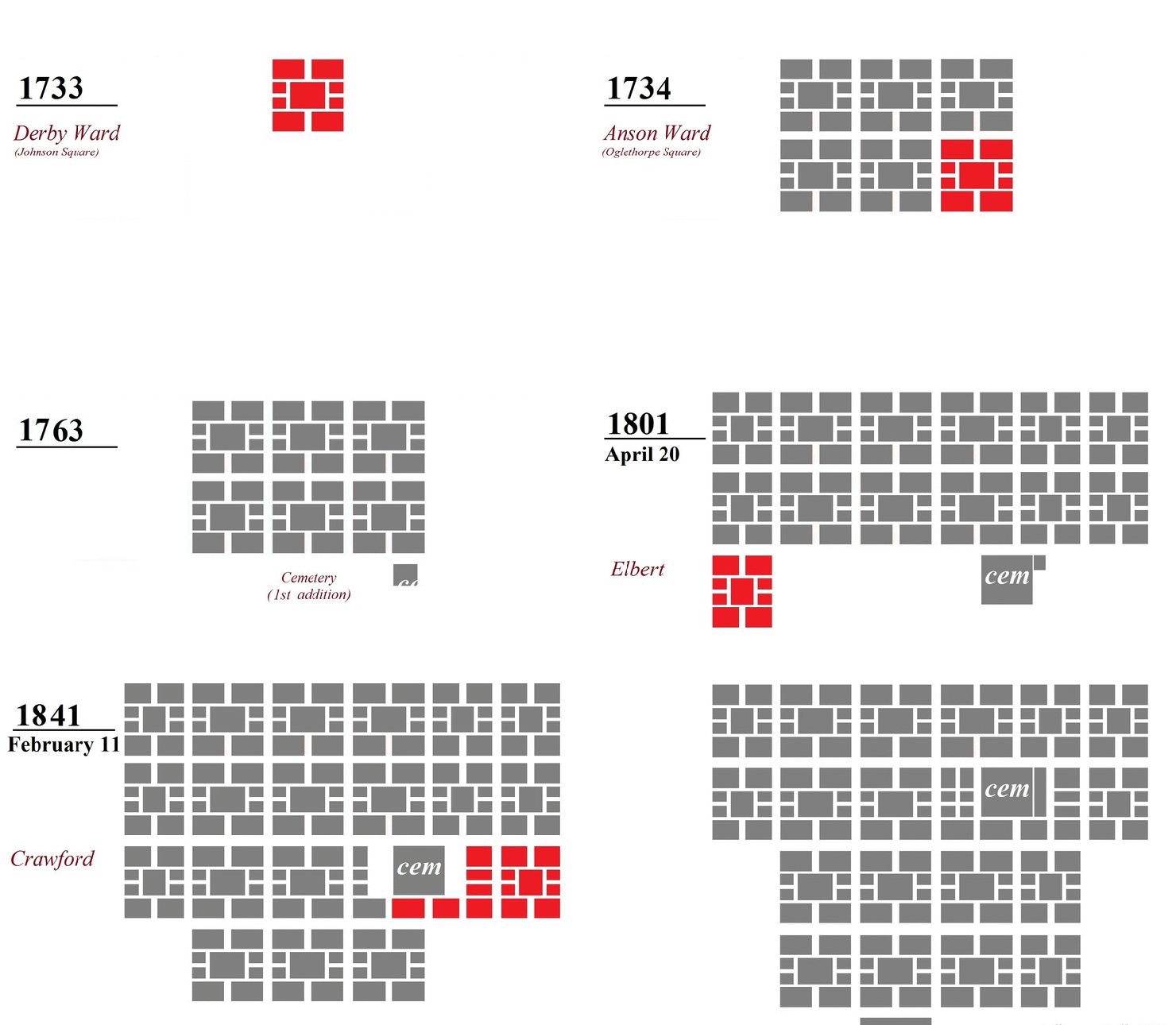
The Squares: Filling in the blanks
Why are there so many squares in Savannah? Was it planned… or was it accidental? Which square came first, and why does every square have 40 house lots? Was there any intentionality in the squares or were they left to our generation as enigmas, like the pyramids? Let’s take a look at how the squares took over town.
-
 Featured
The Squares: The true history of Savannah’s tree history
It was 77 years before the first tree was planted in a square. Three generations of empty space quickly gave way to the next three generations of entirely TOO MUCH in the squares. From firehouses to fences to streetcars, learn how Savannah’s squares overcame various obstacles to become the parks we see today.
-
 Featured
The dates of every historic property in downtown Savannah
If you’ve ever wondered when a certain property was built, or considered whether or not a date plaque on a house is correct (…oftentimes not!), allow me to introduce you to 3 invaluable resources available to you for dating EVERY historic property downtown.
-
 Featured
The Ships that Populated Savannah in 1733
Anyone studying Georgia history knows of the Anne, but there were no fewer than 14 ships that brought colonists to Georgia in the first year. The 650 colonists of the first year filled not only Savannah but created numerous satellite settlements. From Jews to Salzburgers to Irish transport servants, the first year saw a diversity that surprised even the Trustees.
-
 Featured
Savannah’s Colonial Park Cemetery (…and how it became the last cemetery standing downtown)
Walking the pathways of Savannah’s Colonial Park Cemetery there are hints to be found of the “cemetery” that came before the “park.” Begun as a modest parish burial ground outside of town, the South Broad Street Cemetery was retired a century later, beloved and reviled; 5.8 acres of history and legacy buried like a time capsule in the center of town.
-
 Featured
In Their Own Words: George Wells describes the fateful Gwinnett/McIntosh Duel
On Friday, May 16, 1777 two men faced off in a duel, a contest that would claim the life of a signer of the Declaration of Independence and forever cloud the reputation of Georgia’s highest ranking officer.
-
 Featured
“FPoCs…” Free Persons of Color in Savannah
From ice cream establishments to tailoring shops to turtle soup, Free African-Americans promoted their businesses within the newspapers of the first half of the 19th century, proving the African-American experience in Savannah was more complicated then we commonly think today.
-
 Featured
In Their Own Words: Charles Olmstead recalls Savannah in the 1840s
Late in his life Savannah native Charles Olmstead left a written record recalling the Savannah of his youth–a town of deep sand beds and well pumps that dead-ended abruptly at Harris Street. With these recollections Olmstead provides us with an enlightening look at Savannah in the 1840s.
-
 Featured
The bizarre summer without Forsyth Park
In the summer of 1866 Forsyth Park became a battleground between City Council and Reconstruction authorities… a consequence of which was that everyone found themselves locked out of the park.
-
 Featured
The Twelve Towers: The saga of Savannah’s first electric streetlamps
In 1883 twelve towers were erected in Savannah; these early streetlamps stood 150 feet tall. The peculiar towers brought electricity to the town but also introduced incredible practical dangers… and occasionally came crashing down.
-
 Featured
In Their Own Words: the Savannah Morning News’ account of a fatal streetcar accident, 1884
In 1884 a mule-driven streetcar ran over a woman walking through Columbia Square. Ann Berrigan died from her wounds, proving that even before streetcars were electrified, these vehicles were dangerous.
-
Featured
Were the early Georgia colonists debtors? … An excerpt from my book
The Georgia Colony arose out of the Parliamentary Prison Reform Committee; the majority of its early colonists had come on the “Charity Account” of the Trustees. But this raises an interesting question: how many of these colonists were debtors… and had any actually been in prison?
-
 Featured
In Their Own Words: An Old Ghostly Legend About Colonial Park Cemetery
In 1896 George Stone shared with the Savannah Morning News a long-forgotten ghost legend involving the Colonial Park Cemetery and a drunken Christmas Eve reveler.
-
 Featured
Savannah History Narrative: How the Mulberry Grove Changed Everything
Twice visited by George Washington, now a pile of decaying bricks reclaimed by nature, the Mulberry Grove Plantation became the home of General Nathanael Greene and witnessed the invention of the cotton gin, a convoluted tale worth exploring.
-
 Featured
African-American Property Ownership in Savannah’s Tax Digests of 1821 & 1834
In 1820 approximately 80 African-Americans owned real estate in downtown Savannah, assessed at a total value of $50,000. Surprisingly, even slaves owned properties, giving rise to a unique demographic… slaves as home owners.
-
 Featured
Were the 1796 Fires Arson?
On Saturday, November 26, 1796, the heart of the city of Savannah was reduced to ash in the first of its major historical conflagrations. This fire destroyed more a third of the town and was followed by others, begging the question… was it arson?
-
 Featured
In Their Own Words: Richard West Habersham Recounts a Gruesome Duel
On August 23, 1802 a former Savannah mayor killed one of its most prominent citizens in a duel. Years later Richard Habersham heard the details from the survivor. Listen to the bloody tale of the Mitchell-Hunter duel of 1802… and learn what even Habersham never knew.
-
 Featured
In Their Own Words: Carl Brandt and Richard West Habersham Nearly Come to Blows in the Telfair Academy
In 1886 54 year-old Carl Brandt, director of the Telfair Academy, found himself punched on the head and challenged to a duel by a 74 year-old painter.
-
 Featured
Correcting Bad History: “Bad Tour Guide Info” 101
Tour guides tend to learn stories from other tour guides, and in the process the truth often falls by the wayside. …What was the City Pound? …Was the Pink House always pink? …Did Washington really visit the Eppinger House? …Did Oglethorpe really intend all these squares? …And what’s the deal with Ft. Wayne?
-
 Featured
Savannah History Narrative: Sherman’s Occupation of Savannah
On the morning of December 22nd 1864 William Tecumseh Sherman rode north on Bull Street, through the squares and up the deserted avenue. For the next six weeks Savannah, Georgia was under Sherman’s occupation. For Savannah the war was over.
-
 Featured
From Slave House to School House: Rediscovering the Bryan Free School
In early 1865 a slave mart in the heart of downtown Savannah was turned into the city’s first school for its African-American community. From slave house to school house, discover the incredible and unheralded history of the Bryan Free School.
-
 Featured
In Their Own Words: Savannah Morning News did not like “country cows”
Encounters with large livestock were an everyday reality of 19th Century urban life, but in 1885 the Savannah Morning News drew the line at cow stampedes through the streets of downtown Savannah.
-
 Featured
Savannah Day by Day Chronology, 1732-35: 1732
From the passage of the Georgia Charter to the departure of the Anne just five months later (and every relevant happening between); a complete chronology of the 1732 events that would lead to the founding of Colonial Savannah.
-
Featured
Savannah Day by Day Chronology, 1732-35: 1733
The Anne arrives and the colony begins. From Tomochichi to the William & Sarah and the summer sickness; a complete chronology of Colonial Savannah covering the events and activities of 1733
-
Featured
Savannah Day by Day Chronology, 1732-35: 1734
Oglethorpe leaves and the Salzburgers arrive, in town petty squabbles and discontentments grow; a complete chronology of Colonial Savannah covering the events and activities of 1734.
-
Featured
Savannah Day by Day Chronology, 1732-35: 1735
The Red String Plot breaks, the Joseph Watson saga comes to a head, the Turner/Mellichamp counterfeiting scheme is exposed, everyone’s selling rum and Oglethorpe leads the Great Embarkation to Georgia.
-
 Featured
Bonaventure Cemetery
Begun as a plantation, by 1847 Bonaventure had been turned into a cemetery. Here’s a quick primer on better understanding the beauty, elegance and history of Bonaventure.
-
 Featured
The Savannah Port and its 18th Century Slave Trade
Savannah’s participation in the Atlantic slave trade lasted just 23 years, but accounted for nearly 18,000 individuals. How did the slave trade emerge in Savannah? What was the first slave ship to come to Savannah and what was the last? Let’s examine 18th century Savannah’s complicated relationship with slavery.
-
 Featured
In Their Own Words: Richard West Habersham remembers the Telfairs, 1884
In 1835 Margaret Long Telfair rejected the advances of an overconfident French suitor. Our old friend and correspondent Richard West Habersham was a witness.
-
 Featured
Correcting Bad History: Errors in the Tourism Leadership Council’s Tour Guide Manual
Savannah’s Tourism Leadership Council Tour Guide Manual should be the go-to source for tour guides; unfortunately, it is plagued by inaccuracies both large and small.
-
 Featured
Savannah History Narrative: The Earthquake of 1886
In 1886 an earthquake devastated Charleston and rocked Savannah. First-hand accounts illustrate the shock and fury of a night no Savannah resident would forget.
-
 Featured
In Their Own Words: Nelly Kinzie Gordon’s haunting Wolcott story
In 1839 a young boy accidentally ingested poison. Twelve years later his body was discovered perfectly preserved by his still-grieving father.
-
 Featured
Correcting Bad History: The Willink House was not the Deveaux School (…but 513 East York was)
For more than three decades Catherine and Jane Deveaux operated an underground school in heart of downtown Savannah for the education of the town’s African-American children. Some tour guides will point to the first house, others to the second. So who is right?
-
 Featured
“Addressing” Savannah’s Streets: Who they were named for & when they were paved
On July 7, 1733 Oglethorpe named Savannah’s first nine streets. More than a century later Savannah’s address system was created. Street pavements began thereafter, first a trickle, then a flood of different paving materials. Who were the streets named for and when, why & how were they paved?
-
 Featured
Antebellum African-American owned properties still standing in the early Federal wards
In Warren, Washington and Greene Wards today there are properties still standing that were build for Free Persons of Color before the Civil War. These houses, dating back to 1810 or before, are a testament to Savannah’s African-American community.
-
 Featured
Correcting Bad History: Sherman and the Bells of St. John’s
Another tale that has led countless tour guides to be dashed against the rocks of credulity with its siren song. It’s time to dispel an age-old myth about Sherman’s threat to melt down the chimes of a Savannah church.
-
 Featured
Lafayette’s Visit to Savannah, March 19 – 21, 1825
For 50 hours in March of 1825, Lafayette visited Savannah. Two Savannah newspapers covered every public moment of his visit. Did he ever really speak from that Owens-Thomas balcony?
 Fact-Checking Savannah's History
Sаνed as a favoгite, I really like your website!
LikeLike
Savannah Georgia really has such a rich history. Thanks to https://www.visitsavannah.com/historic-landmark-district , I was able to know about great places to visit there specially the ones in the Downtown area!
LikeLike